
 Member Dashboard
Since NAFEM’s last advocacy issues survey in 2023, what once felt like short-term disruption has become a lasting reality. Volatility is no longer temporary; it’s part of today’s foodservice equipment and supplies industry and a microcosm of the overall business landscape.
Members responding to NAFEM’s 2026 advocacy issues survey report that tariffs and regulatory complexity are limiting their abilities to manage costs, invest strategically and pursue growth. While the 2023 survey reflected post-pandemic challenges such as extended lead times, shipping delays and material shortages, the 2026 findings signal a shift. Trade policy uncertainty and tariff exposure have become long-term strategic concerns that complicate forecasting and capital investment decisions.
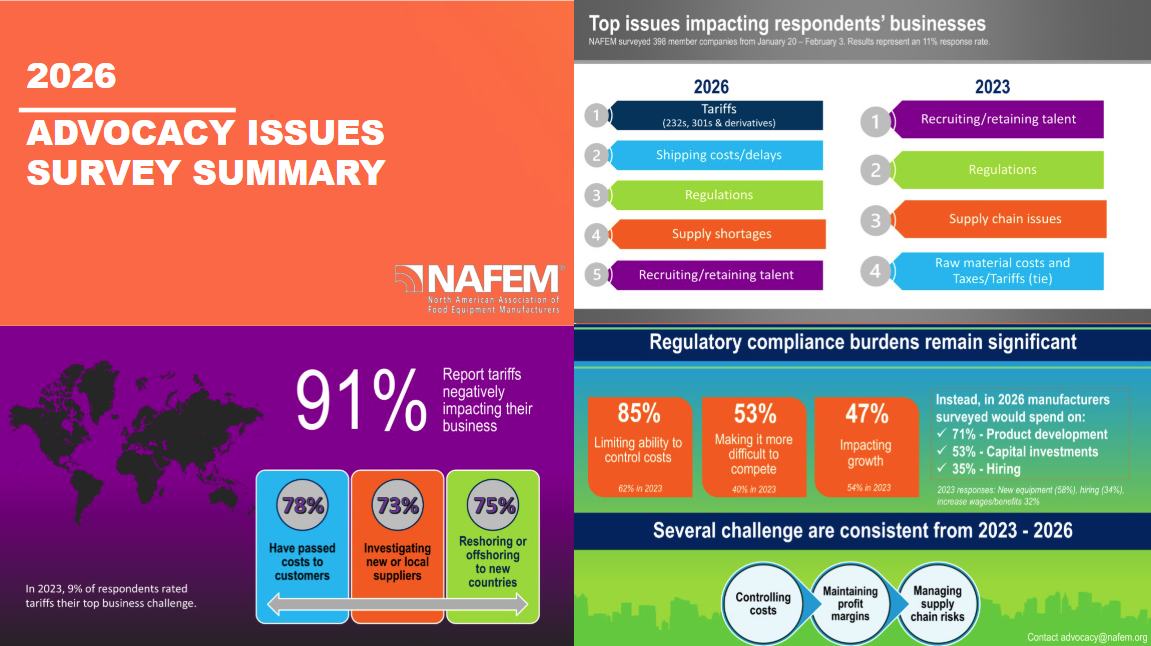
Despite shifting conditions, some challenges remain constant in the 2023 and 2026 surveys:
- Cost control is still the top priority
- Profit margins remain under pressure
- Supply chain risk persists
The industry’s response, however, has evolved. In 2023, many companies absorbed higher costs and implemented short-term price increases in response to tariffs. In 2026, manufacturers report taking a more strategic approach by diversifying suppliers, exploring nearshoring and reshoring options, and formalizing contingency plans to better manage uncertainty.
Tariffs now rank as the top business challenge, with 91% reporting negative impacts and 78% passing on costs to customers. In 2023, 9% of respondents rated tariffs the highest business challenge, far behind recruiting/retaining talent (37%) and regulations (30%).
Additionally, 85% say regulatory compliance limits their ability to control costs, versus 62% in 2023, and nearly half report impacts to growth, versus more than half in 2023. If compliance burdens were reduced today, manufacturers would redirect spending to product development, capital investment and hiring. In 2023, respondents would have purchased new equipment (58%), hire (34%) and increase wages/benefits (32%).
NAFEM will share these results as we advocate for policies that strengthen businesses, employees and communities. Thank you to the members who contributed to the study.